Grade 2–4Common Core (CCSS) · Math
Math Worksheets for Ages 8–10 (grades 2–4)
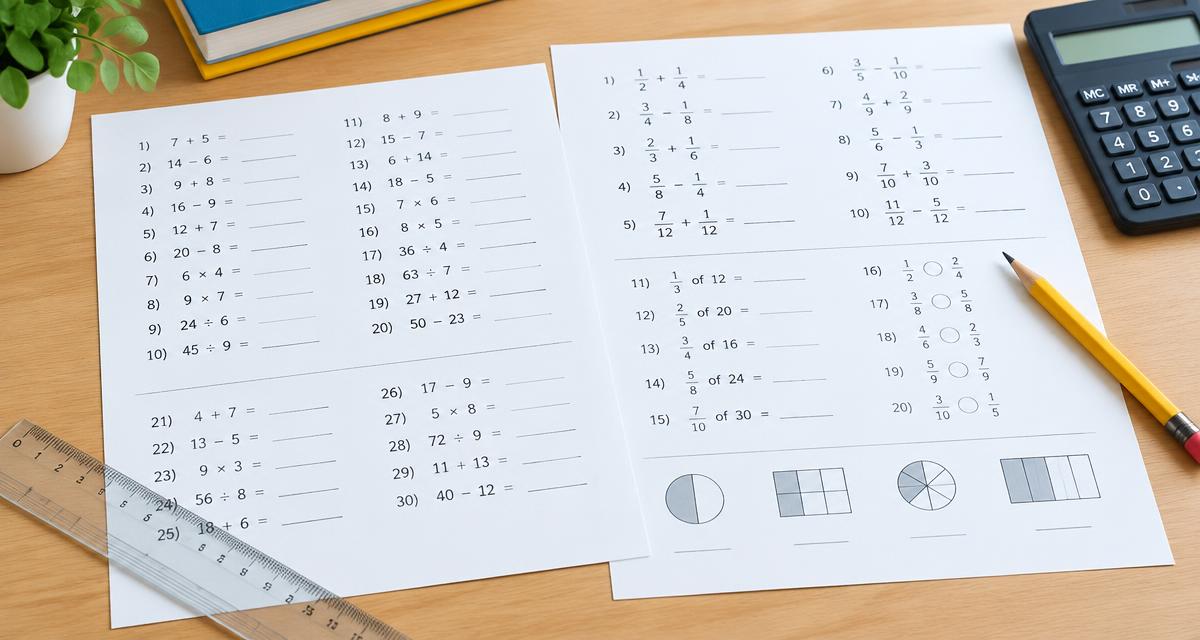
A ready-made mixed review for grades 2–4, covering column addition and subtraction, times tables, simple fractions, time and money. Print it or pick a single topic below.
Step 1 of 5
Choose an area
Your choices
- Area
- Review
- Exercise type
- Mixed review of all areas
- Age
- 8–10 years
- Difficulty
- Easy
- Number of tasks
- 20
- Task format
- Mixed
- Paper size
- US Letter
Your choices
- Area
- Review
- Exercise type
- Mixed review of all areas
- Age
- 8–10 years
- Difficulty
- Easy
- Number of tasks
- 20
- Task format
- Mixed
- Paper size
- US Letter
More options
Settings are saved only in this browser on this device. No account needed.
More options
Feel free to describe the error, e.g. which worksheet and problem. Do not send personal data or pupil information.
Mixed review of all areas · 8-10 years
Name: ____________________Elias has 99 stickers and gets 71 more. How many stickers are there now? Answer with the correct unit.
A print order has 15 booklets of 9 pages each. How many pages are printed? Answer with the correct unit.
Calculate: 21 + 16 =
Sara saves 5 kr in week 1 and 3 kr more each week than the week before. How much is saved in week 8? Answer with the correct unit.
A bottle holds 8 l of juice. How many millilitres is that? Answer with the correct unit.
A road is 55 m long. 28 m have been painted. How many metres are left to paint? Answer with the correct unit.
Share 20 dots equally between 4 empty boxes. How many go in each box? 20 ÷ 4 = __.

Show your thinking:
The train leaves at 14:55 and arrives at 16:00. How long is the trip? Answer with the correct unit.
Write the next two numbers: 9, 11, 13, 15, __, __
Rectangle: 8 cm × 4 cm. Calculate the perimeter and area of the rectangle.
Calculate: 12 + 82 =
18 pages are read over 2 days, the same number each day. How many pages are read per day? Answer with the correct unit.
Write the number shown in the picture.

Show your thinking:
Leo saves 5 kr in week 1 and 4 kr more each week than the week before. How much is saved in week 7? Answer with the correct unit.
Calculate: 7 cm = __ mm
A road is 58 m long. 38 m have been painted. How many metres are left to paint? Answer with the correct unit.
Count all the dots: 4 groups of 5. 4 × 5 = __.

Show your thinking:
Calculate the time between 15:20 and 16:30. Answer in hours and minutes.
Row 1 in a hall has 9 seats, and every row has 2 more than the one before. How many seats are in row 7? Answer with the correct unit.
Calculate: 6 l = __ ml
Answer key
- 1. 170 stickers
- 2. 135 pages
- 3. 37
- 4. 26 kr
- 5. 8000 ml
- 6. 27 m
- 7. 5
- 8. 1 h 5 min
- 9. 17, 19
- 10. Perimeter = 24 cm, Area = 32 cm²
- 11. 94
- 12. 9 pages
- 13. 16
- 14. 29 kr
- 15. 70 mm
- 16. 20 m
- 17. 20
- 18. 1 h 10 min
- 19. 21 seats
- 20. 6000 ml
Topics on this worksheet
Areas on this sheet
- Number sense · 15
- Algebra · 4
- Geometry · 1
How to use the tool
- The page opens a mixed review for this age group.
- Change area, exercise type, level or number of tasks if you like.
- Print or save as PDF; “Create new version” gives a new sheet.
About this generator
This page collects everything pupils aged 8–10 (grades 2–4) typically practise: column addition and subtraction, times tables, simple fractions, time and money. The default sheet mixes all areas — addition and subtraction, multiplication and division, number sense, fractions, percent, algebra, geometry and statistics — at a level suited to the age group, so it works well as a weekly review, a diagnostic before a new unit or homework. Switch to a single area to focus on one skill. The answer key is calculated by the website and includes units for every word problem. No sign-up and no personal data.
Popular uses
- Weekly mixed review
- Diagnostic before a new unit
- Homework
- Substitute teacher lessons
More math worksheets by topic
- Percentage worksheets
- Fraction worksheets
- Equation worksheets
- Algebra worksheets
- Decimal worksheets
- Time worksheets
- Area and perimeter worksheets
- Statistics worksheets
- Division worksheets
- Subtraction worksheets
- Volume worksheets
- Unit conversion worksheets
- Mean and median worksheets
- Multi-step maths worksheets
- Pythagorean theorem worksheets
- Linear function worksheets
- Proportion worksheets
- Interest worksheets
- Exponent and square root worksheets
- Systems of equations worksheets
- Mixed math review (ages 14–16)
- Math worksheets grade 1
- Math worksheets grade 2
- Math worksheets grade 3
- Math worksheets grade 4
- Math worksheets grade 5
- Math worksheets grade 6
- Math worksheets grade 7
- Math worksheets grade 8
- Math worksheets grade 9
- Math worksheets grade 10
- Math worksheets grade 11
- Math worksheets grade 12
- Quadratic function worksheets
- Trigonometry worksheets
- Exponential function worksheets
- Logarithm worksheets
- Arithmetic sequence worksheets
- Derivative worksheets
- Integral worksheets
- Vector worksheets
- Standard deviation worksheets
- Sine and cosine rule worksheets
- Polynomial equation worksheets
- Inequality worksheets
- Circle equation worksheets
- Math worksheets ages 6–8 (grades 1–2)
- Math worksheets ages 10–12 (grades 4–6)
- Math worksheets ages 12–14 (grades 6–8)
- Math worksheets ages 14–16 (grades 8–10)
- Weekly math worksheet
- 2nd grade addition and subtraction worksheets
- 3rd grade multiplication worksheets
- 4th grade fractions worksheets
- Long division worksheets
- 5th grade decimals worksheets
- 6th grade fractions worksheets
- 6th grade equations worksheets
- Pre-algebra worksheets
Frequently asked questions
- How do I pick the right level?
- Choose an age or grade in step 2. Start easier if the pupil is unsure – you can switch anytime and get new problems instantly.
- Can I see the problems before printing?
- Yes. The sheet shows exactly the problems that will print. Click New problems to swap them.
- How do I include an answer key?
- Turn on Answer key in the last step. It prints on its own page after the problems, with the same numbering.
- What does the question mark next to a problem do?
- It opens a step-by-step explanation of the method on screen. It is not printed and does not reveal the answer.
- What do pupils aged 8–10 practise?
- Typically column addition and subtraction, times tables, simple fractions, time and money.
- Is there an answer key?
- Yes, printed last, with units for word problems.